Welcome to PyLogGrid’s documentation!
About
PyLogGrid is a Python-based framework for running and analyzing numerical simulations on log-lattices [1]. The log-lattice structure is particularly useful for modeling phenomena that exhibit multi-scale behavior, such as turbulence. PyLogGrid is designed to be flexible, customizable, and easy to use.
This framework has been used in several scientific papers such as [2], [3].
The framework includes a variety of built-in tools for analyzing simulation results, including visualization tools and post-processing scripts.
A barebones matlab framework by another research team can be found here [4].
The philosophy
Sparse Fourier simulations
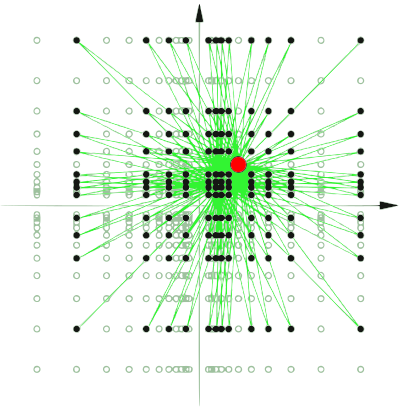
Simulate complex systems spanning multiple scales with our numerical library. Gain insights previously unattainable with classical simulations.
Designed for physicists

Our library provides an intuitive and user-friendly interface for simulating and analyzing complex systems, so you can focus on your research rather than coding.
Python + C for High Performance

Our library combines the ease of use and readability of Python with the speed and performance of compiled C. Get the best of both worlds for optimized execution speed.